Computational Logic
Computational Logic
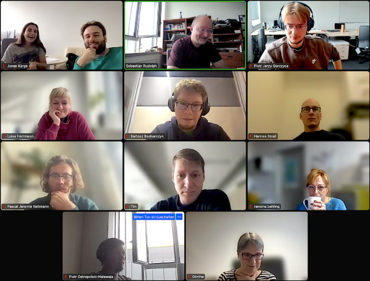
- Kontaktperson Sebastian Rudolph
- Sekretariat cl@tu-dresden.de
Die Forschungsgruppe Computational Logic (CL) befasst sich mit Modellierung und automatischem Schließen in der logikbasierten Wissensrepräsentation. Dabei gilt unser Interesse sowohl den mathematischen und formalen Grundlagen diverser Paradigmen der Wissensrepräsentation als auch deren Anwendungen in Gebieten wie dem Semantic Web, Wissensakquise, Argumentation, etc.
Inspiriert durch diesen Gebieten entstammende Fragestellungen befassen wir uns auch mit Themen aus angrenzenden Forschungsfeldern wie beispielsweise Datenbanktheorie und Computerlinguistik.
Die Computational Logic Group ist außerdem auf LinkedIn, Facebook, Bluesky und YouTube präsent.
Professoren und Gruppenleiter

Verwaltung


Wissenschaftliche Mitarbeiter




Techniker

Ehemalige


Ehemalige Gäste

Neueste Publikationen
Komplette Publikationsliste anzeigen
Paraconsistent Semantics for Extended Fuzzy Logic Programs via Approximation Fixpoint Theory
The 10th International Joint Conference on Rules and Reasoning, to appear
Details
Assumption-Based Argumentation Through the Lens of Approximation Fixpoint Theory
In Katie Atkinson, eds., Proceedings of the Eleventh International Conference on Computational Models of Argument (COMMA), 437–448, 2026. IOS Press
Details Download
On the Complexity of Initial Models in Abstract Dialectical Frameworks
In Katie Atkinson, eds., Proceedings of the Eleventh International Conference on Computational Models of Argument (COMMA), 113–124, 2026. IOS Press
Details Download
Optimizing Proof-Search via Linearization for Gödel-Löb Logic with Tree-Hypersequents
In Giorgio Bacci and Mickaël Randour, eds., Proceedings Seventeenth International Symposium on Games, Automata, Logics, and Formal Verification (GandALF 2026), volume 454, 148-164, 2026. Electronic Proceedings in Theoretical Computer Science
Details
Non-Wellfounded and Cyclic Proofs for LTL: A Syntactic Correspondence with Linear Nested Sequents
In Giorgio Bacci and Mickaël Randour, eds., Proceedings Seventeenth International Symposium on Games, Automata, Logics, and Formal Verification (GandALF 2026), volume 454, 165-182, 2026. Electronic Proceedings in Theoretical Computer Science
Details
Non-Wellfounded and Cyclic Proofs for LTL: A Syntactic Correspondence with Linear Nested Sequents
Technical Report, TU Dresden, 2026
Details Download
Foundations for an Abstract Proof Theory in the Context of Horn Rules
ACM Transactions on Computational Logic, 27(4), October 2026
Details
Pseudo-Closed Family Verification is NP-Complete (Or: How Claude Helped Tackle Bernhard’s Problem)
In Madalina Croitoru, Domingo López-Rodríguez, Gerd Stumme, eds., The Third International Joint Conference on Conceptual Knowledge Structures (CONCEPTS 2026), volume 16811 of LNCS, 3-19, 2026. Springer
Details Download
Standpoint Logics with Defeasible Beliefs
In Ana Ozaki, Nico Potyka, eds., Proceedings of the 24th International Workshop on Non-Monotonic Reasoning (NMR 2025), volume 4239 of CEUR, 2026
Details Download
Stratified Negation in RDF Rules: A Correct Approach
In Manolis Koubarakis, Maria-Esther Vidal, Axel Polleres, Marieke van Erp, Ernesto Jimenez Ruiz, Oshani Seneviratne, Lora Aroyo, Gianluca Demartini, Reham Alharbi, Roberto Barile, Claudia d'Amato, Valentina Tamma, eds., Proceedings of the 25th International Semantic Web Conference (ISWC 2026), to appear. Springer
Details Download
Lehrveranstaltungen
- Seminar „Knowledge Representation“ (WS 2026)
- Advanced Problem Solving and Search (WS 2026)
- Foundations of Knowledge Representation (WS 2026)
- Foundations of Logic Programming (WS 2026)
- Proof Theory and Sequent Systems (WS 2026)
weitere Lehrveranstaltungen anzeigen
Studienarbeiten
Themenvorschläge für Studien- und Abschlussarbeiten
- Master's Thesis Projects in Symbolic Logic, Proof Theory, and Theorem Proving
- Betreuer: Tim Lyon
- Verfügbar als Thema einer Masterarbeit
Abgeschlossene Arbeiten
- Automated Proof-Search for Gödel-Löb Provability Logic via Tree Sequents
- von Omar Y. A. A. Taher (12 September 2025)
- Betreuer: Tim Lyon
- Justifications under the Fixed-Domain Semantics
- von Satyadharma Tirtarasa (28 September 2017)
- Betreuer: Sebastian Rudolph, Lukas Schweizer
- Using (Deep) Reinforcement Learning To Play Angry Birds
- von Peter Hirsch (26 September 2017)
- Betreuer: Lukas Schweizer
- Solving Angry Birds with Reinforcement Learning
- von Richard Kwasnicki (23 Februar 2017)
- Betreuer: Sarah Alice Gaggl, Lukas Schweizer
- Solving Angry Birds with Reinforcement Learning
- von Julius Gonsior (23 Februar 2017)
- Betreuer: Sarah Alice Gaggl, Lukas Schweizer
- Visualisierung von Lösungen in Abstrakten Argumentation Frameworks
- von Rajwardhan Kumar (27 Oktober 2016)
- Betreuer: Sarah Alice Gaggl
- Combining Belief Revision and Abstract Dialectical Frameworks
- von Umer Mushtaq (13 Oktober 2016)
- Betreuer: Sebastian Rudolph, Sarah Alice Gaggl
- Encoding Belief Revision Operators in Abstract Dialectical Frameworks
- von Umer Mushtaq (7 Oktober 2016)
- Betreuer: Sebastian Rudolph, Sarah Alice Gaggl
- On the Computation of Naive-based Argumentation Semantics
- von Javanshir Alammadli (14 März 2016)
- Betreuer: Sebastian Rudolph, Sarah Alice Gaggl
- Navigation Approaches for Answer Sets
- von Asmaa Afeefi (4 Dezember 2015)
- Betreuer: Sarah Alice Gaggl, Sebastian Rudloph
- Intertranslatability of Labeling-Based Argumentation Semantics
- von Umer Mushtaq (19 November 2015)
- Betreuer: Sarah Alice Gaggl
- Implementierung eines labelingbasierten Algorithmus für die cf2 Argumentation Semantik
- von Javanshir Alammadli (20 April 2015)
- Betreuer: Sarah Alice Gaggl
- Grounded Circumscription in Description Logics
- von Efstathios Delivorias (9 April 2015)
- Betreuer: Sebastian Rudolph
- Solving Product Configuration Problems using Non-standard Reasoning Services
- von Lukas Schweizer (11 Juli 2014)
- Betreuer: Sebastian Rudolph, Sarah Alice Gaggl

CPEC
Grundlagen verständlicher Softwaresysteme

M/EDGE
Vertrauenswürdige und energiesparsame Edge-Elektronik für medizinische Anwendungen
SECAI
School of Embedded Composite Artificial Intelligence

SEMECO-Q2
Sichere Medizinische Mikrosysteme und Kommunikation: KI-assistierte Regulatorik für Medizin und Cybersecurity

ScaDS.AI
Center for Scalable Data Analytics and Artificial Intelligence

Wolpertinger
Wolpertinger is a fixed-domain reasoner