Wissensbasierte Systeme
Wissensbasierte Systeme
- Kontaktperson Markus Krötzsch
- Sekretariat secretary_wbs@mailbox.tu-dresden.de
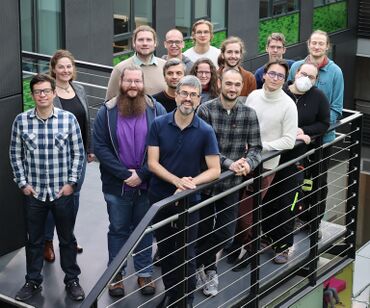
In der Forschungsgruppe Wissensbasierte Systeme beschäftigen wir uns mit Methoden der intelligenten Verwaltung und Verarbeitung von Informationen in Computersystemen. Unsere Arbeitsgebiete liegen dabei besonders im Bereich der symbolischen Künstlichen Intelligenz (KI) und der logischen Methoden in der Informatik. Dies umfasst Fragestellungen der Wissensrepräsentation und des logischen Schließens, der diskreten Optimierung und Problemlösung, sowie der Datenbanken. Unsere Arbeit verbindet dabei erkenntnisorientierte Grundlagenforschung mit angewandten Arbeiten bishin zur Entwicklung praktischer Systeme.
Die Forschungsgruppe ist am Institut für Theoretische Informatik der Fakultät Informatik angesiedelt und gehört darüber hinaus zum Center for Advancing Electronics der TUD.
Professoren und Gruppenleiter

Verwaltung


Wissenschaftliche Mitarbeiter


Techniker

- APB 3018
- +49 (0) 351 463-38422
Studentische und Wissenschaftliche Hilfskräfte

Ehemalige


- Ehemals Wissenschaftlicher Mitarbeiter
- Wissensbasierte Systeme, Logische Programmierung und Argumentation


- Ehemals Wissenschaftliche Mitarbeiterin
- Automatentheorie, Wissensbasierte Systeme

Neueste Publikationen
Komplette Publikationsliste anzeigen
SPARQLing Datalog for Rule-Based Reasoning over Large Knowledge Graphs (Extended Abstract)
In Marco Calautti, Matthias Lanzinger, eds., Proceedings of the 6th International Workshop on the Resurgence of Datalog in Academia and Industry (Datalog-2.0 2026), CEUR Workshop Proceedings, to appear. CEUR-WS.org
Details Download
Stratified Negation in RDF Rules: A Correct Approach
In Manolis Koubarakis, Maria-Esther Vidal, Axel Polleres, Marieke van Erp, Ernesto Jimenez Ruiz, Oshani Seneviratne, Lora Aroyo, Gianluca Demartini, Reham Alharbi, Roberto Barile, Claudia d'Amato, Valentina Tamma, eds., Proceedings of the 25th International Semantic Web Conference (ISWC 2026), to appear. Springer
Details Download
Computing Extensions of Abstract Argumentation Frameworks by Enumerating Closed Sets
In Marie-Laure Mugnier, Franz Baader, eds., Proceedings of the 23rd International Conference on Principles of Knowledge Representation and Reasoning, KR 2026, Lisbon, Portugal, 2026
Details Download
Lattice-Based Approaches for Enumerating Stable Extensions in Abstract Argumentation Frameworks
In Madalina Croitoru, Domingo López-Rodríguez, Gerd Stumme, eds., The Third International Joint Conference on Conceptual Knowledge Structures (CONCEPTS 2026), volume 16811 of LNCS, 122-137, 2026. Springer
Details Download
Evaluating a Visual Query Tracer and Builder for Learning Declarative Logic Programming
VIS 2026, to appear
Details Download
Recovering Explanations from Transformed Rule-Based Ontologies
In Manolis Koubarakis, Maria-Esther Vidal, Axel Polleres, Marieke van Erp, Ernesto Jimenez Ruiz, Oshani Seneviratne, Lora Aroyo, Gianluca Demartini, Reham Alharbi, Roberto Barile, Claudia d'Amato, And Valentina Tamma, eds., Proceedings of the 25th International Semantic Web Conference (ISWC 2026), to appear
Details Download
The Chase in Lean - Crafting a Formal Library for Existential Rule Research
In Renata Wassermann, Marie-Laure Mugnier, Franz Baader, eds., Proceedings of the 23rd International Conference on Principles of Knowledge Representation and Reasoning, volume 23 of Proceedings of the International Conference on Principles of Knowledge Representation and Reasoning, 346--356, 2026. IJCAI Organization
Details Download
SPARQLing Datalog for Rule-Based Reasoning over Large Knowledge Graphs
In Maribel Acosta, Marieke van Erp, Sebastian Rudolph, Olaf Hartig, Blerina Spahiu, Anisa Rula, Daniel Garijo, Francesco Osborne, eds., Proceedings of the 23rd European Semantic Web Conference (ESWC 2026), Part I, volume 16549 of LNCS, 518-536, 2026. Springer
Details Download
Nemo at v0.10: Explainable Web Rule Reasoning for RDF, SPARQL, and More
In Maribel Acosta, Marieke van Erp, Sebastian Rudolph, Olaf Hartig, Blerina Spahiu, Anisa Rula, Daniel Garijo, Francesco Osborne, eds., Supplementary Proceedings of the 23rd European Semantic Web Conference (ESWC 2026), LNCS, to appear. Springer
Details Download
Declarative Debugging for Datalog with Aggregation
In Alexander Krause, João Felipe Pimentel, eds., Proceedings of the Workshops of the EDBT/ICDT 2026 Joint Conference (EDBT/ICDT-WS 2026), Tampere, Finland, March 24, 2026, volume 4192 of CEUR Workshop Proceedings, 2026. CEUR-WS.org
Details Download
Lehrveranstaltungen
- Complexity Theory (WS 2026)
- Knowledge Graphs (WS 2026)
- Theoretische Informatik und Logik (SS 2026)
- Knowledge Graphs (WS 2025)
- Formale Systeme (WS 2025)
weitere Lehrveranstaltungen anzeigen
Studienarbeiten
Abgeschlossene Arbeiten
- Optimierung des logischen Schließens mit existentiellen Regeln durch die Analyse von Abhängigkeiten
- von Alex Ivliev (9 Dezember 2021)
- Betreuer: Markus Krötzsch
- Chase-Based Computation of Cores for Existential Rules
- von Lukas Gerlach (29 August 2021)
- Betreuer: Markus Krötzsch
- Evaluating the Generality of Disjunctive Model Faithful Acyclicity on OWL ontologies
- von Lukas Gerlach (31 März 2021)
- Betreuer: Markus Krötzsch, David Carral
- Don’t Repeat Yourself: Termination of the Skolem Chase on Disjunctive Existential Rules
- von Lukas Gerlach (30 September 2020)
- Betreuer: Markus Krötzsch, David Carral
- Software Implementation for Taxonomy Browsing and Ontology Evaluation for the case of Wikidata
- von Serghei Stratan (7 März 2016)
- Betreuer: Markus Krötzsch
- Visualisierung räumlich-zeitlicher Inhalte aus Wikidata
- von Georg Wild (4 September 2014)
- Betreuer: Markus Krötzsch

CPEC
Grundlagen verständlicher Softwaresysteme

CeTI
Centre for Tactile Internet with Human-in-the-Loop

Nemo
Ein schnelles, skalierbares und verlässliches Regelsystem
SECAI
School of Embedded Composite Artificial Intelligence

ScaDS.AI
Center for Scalable Data Analytics and Artificial Intelligence

Semantic MediaWiki
Beliebte Open-Source-Software zur gemeinsamen Datenverwaltung

Wikidata
Wikipedias freie, kollaborative Wissensbasis

Wikidata SPARQL Logs
Zugriffsprotokolle des Wikidata SPARQL Query Service
Adf-bdd
Abstract Dialectical Frameworks mit Binary Decision Diagrammen lösen